
Trace Graham County Former Owners
Graham County posts no online deed index. No public grantor-grantee search runs on its official pages. So former-owner work begins at the Register of Deeds and widens into archival sources whenever the county's own books point farther back.
| Source | Years It Covers | Where Held | What It Shows |
|---|---|---|---|
| Grantor-grantee books | County recording era; exact run requires office confirmation | Graham Register of Deeds | Parties, instrument, date, book and page |
| Recorded plats | Varies by townsite and subdivision | Register and historical collections | Original lot, block, streets and later changes |
| Federal tract and patent sources | Settlement and patent era | Kansas State Historical Society and federal sources | Original land entry and patent clues |
| Newspapers and directories | Title and year vary | KSHS and Graham County Public Library | Legal notices, residents, businesses and estates |
Start with the newest deed, even for an old house. It anchors everything. The grantor and legal description there give a controlled step to the prior owner, and historic sources add color only when matched back to the recorded land.
Graham's Deed Index Is Offline
The Graham County Register of Deeds records deeds, mortgages, plats, liens, powers of attorney, and oil and gas leases. The office page lists record types and contact routes. It offers no searchable web index. Former owners must be traced at the office. A written request works too. Title and abstract professionals can also run the search. Ask for both direct and reverse index entries, since a direct index runs by grantor and a reverse index follows grantees, and confirm the local book arrangement with staff rather than assuming a coverage year.
Graham Names Shift Across Time
Historic names can defeat an address search. One Morland description still reads “Original Town of Fremont, now City of Morland.” Hill City deeds cite Fairview Addition. Others there name a vacated street, while rural deeds may rely on section, township, and range rather than a modern road address. When a map and the old description disagree, retrieve the plat or vacation record itself. That local quirk beats guessing.
Walk Graham's Deed Chain Backward
A backward chain is just recorded transfers in reverse. Keep a log, so each prior owner ties to an instrument rather than a surname.
- Find the current acquiring deed and record its date, type, book, page, and legal description.
- Read the grantor, who is the prior owner conveyed from.
- Search that grantor as a grantee to find how that party acquired the tract.
- Repeat in earlier index books, checking plats, probate, and court files when a transfer is indirect.
- Grantor and grantee
- The party conveying an interest and the party receiving it.
- Chain of title
- The ordered record of transfers affecting one tract.
- Reverse index
- An index organized by grantee rather than grantor.
- Warranty and quitclaim
- Different deed forms; neither label alone proves the quality of title.
Nicodemus Extends Graham Land History
Nicodemus offers an exceptional ownership trail for Graham County. National Park Service research counts 114 homestead patents covering 18,126 acres by 1899. Federal tract books and patents can name the first federal transfer. County deeds show every later change. The NPS Nicodemus history adds settlement context. A University of Kansas archival finding aid adds family context. Treat those as leads. Then confirm any former owner against the patent, deed, plat, or probate record for the tract.
Millbrook Can Appear in Graham Records
A tornado damaged Millbrook in August 1887. The county seat then moved to Hill City in March 1888, so early administrative references may point to Millbrook even though modern county offices sit in Hill City. None of this proves a record was lost. Search both place names. Ask the Register how its earliest books are indexed, because the seat move is a documented clue rather than permission to invent a gap.
Libraries Add Former-Owner Context
The Graham County Public Library can help with newspapers, directories, local history, and microfilm. The Kansas State Historical Society's newspaper database searches by city, title word, county, and date range. Legal notices join names to lots and blocks. Directories and obituaries suggest occupancy. Occupation is not ownership. Pair every personal-history clue with the deed or tax record for the same legal description.
Build a Graham Transfer Timeline
A research log turns scattered references into a chain. Give each row a transfer date, grantor, grantee, deed type, book and page or instrument number, and the legal description exactly as written. Note any change from a split, combination, corrected deed, street vacation, or new plat. Memory is not a source. Never fill a missing transfer from family lore.
| Transfer date | Grantor to grantee | Deed type | Book or page |
|---|---|---|---|
| Newest verified date | Current deed parties | As recorded | Office reference |
| Prior verified date | Previous deed parties | As recorded | Office reference |
| Earlier verified date | Earlier deed parties | As recorded | Office reference |
Sample rows are structure, not data. Fill them only from records the custodian supplies. If a deed cites a probate estate, sheriff's deed, tax foreclosure, or quiet-title judgment, follow that citation into the Kansas district-court record, then return to the next recorded transfer. Historic newspapers can close a context gap. They help most when they print legal descriptions. The 2024 Graham tax-foreclosure notices show Hill City additions, Morland's Fremont wording, Nicodemus tracts, and Bogue lots. A notice proves what was published then. It does not prove a parcel stayed delinquent. Nor does it prove the named party was the final owner of record.
Probate Can Bridge Graham Owners
An owner's death can break a clean seller-to-buyer pattern. So can a court-ordered transfer. An estate may then convey the land, and the deed index will list an executor, administrator, trustee, sheriff, or estate instead of the familiar former owner. Keep that capacity exactly as written. Follow the case reference rather than skipping to the next matching surname.
Graham County district court access splits between the Kansas Public Portal and the clerk's counter. Online eCourt coverage has no verified Graham start year. Some records cannot be reached remotely. Search the case number from the deed first. If no number appears, search the decedent, estate, or fiduciary name in a focused date range, then confirm the parcel description in the file.
A probate order explains who held authority to convey. The recorded personal representative's deed carries the actual transfer of land. Both documents can matter for tracing previous owners. Newspaper probate notices and obituaries add family context, but neither proves that an heir received a specific parcel. Match each conclusion to the court order and instrument.
Tax foreclosure warrants the same care. Graham County public notices published exact legal descriptions in 2024, but a notice only marks a procedural stage. It does not establish the final buyer or the parcel's present status. Follow the petition, judgment, sale, confirmation, and resulting recorded instrument so a historical chain never treats a planned sale or allegation as a completed transfer.
Federal Patents Start Some Graham Chains
A federal patent is often the earliest move of land from the United States into private hands. It is not the whole ownership history. The Kansas State Historical Society points researchers to tract books, patents, surveys, county deeds, plats, and maps. Identify the patent through its federal land description, then move forward through Graham County deeds.
Nicodemus makes this route especially useful. National Park Service sources tie the settlement to a large documented group of homestead patents. A patent establishes the named patentee and tract. Later county instruments show sales, inheritances, divisions, and mortgages. Family papers and oral histories add context only after the land match is secure.
Some chains begin with a townsite plat, not a rural patent. For Hill City, Bogue, or Morland lots, find the original plat and the first deed conveying the specific lot. A lot number alone is incomplete. Record the addition or townsite name too. Noting both historic and current place names keeps later index searches from silently skipping a former owner.
How Far Graham Ownership Goes
Graham County deeds run deep, and no single cutoff year marks where the online record stops. The Register of Deeds books carry the chain back through the earliest entries, helped along by recorded plats, KSHS land resources, and federal patent sources. Coverage differs by series, so confirm each one directly.
Some transfers break a clean buyer-seller line. Estates, probate, sheriff's sales, and tax foreclosures all redirect ownership outside the usual deed pattern. When a deed mentions a case or a fiduciary, check the district court record and the legal notices for the rest of the story.
No online cutoff to quote. Older Graham County former owners require office books and archives. Use the chain for land history and lawful diligence, never harassment.
The Graham County Register of Deeds page names the office that holds the instruments a former-owner search depends on. Deed books and indexes live there.
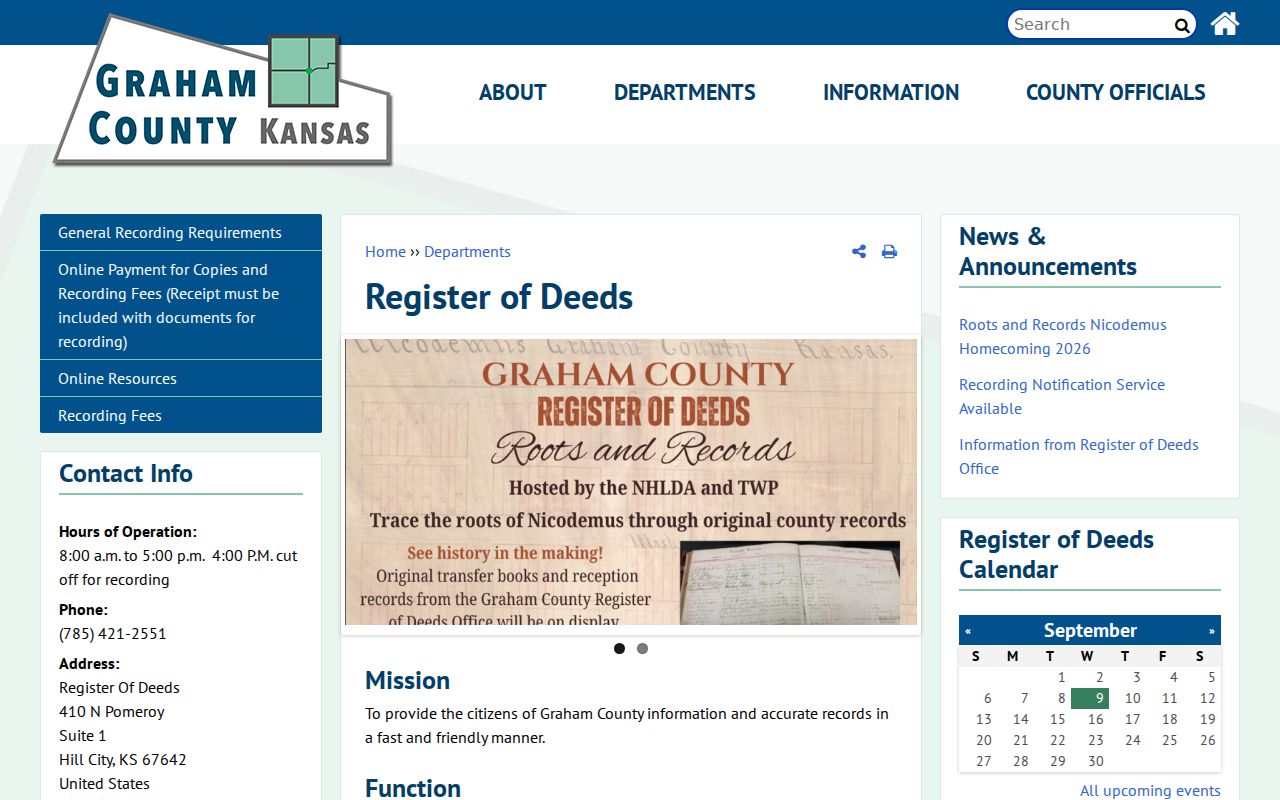
That page is a routing source only. The chain itself still requires deed indexes, books, and instrument references from the office.