
Search Graham County Property Records
Start with the Graham County ORKA map whenever an address or map location is in hand. The parcel viewer ties a spot on the map to parcel attributes and a legal description. Working from a name alone? Try exact spellings first. Then confirm every match against the tract itself, because trusts, estates, LLCs, initials, and same-name parties can create false joins in any Graham County property search.
Remember that separate offices keep separate records. The Appraiser values the parcel. The Register of Deeds holds the deed. The Treasurer tracks the tax roll, and the district court keeps its own files. No single result stands in for the rest, and a map line is never a survey.
- Locate the address or rural tract in ORKA and note the legal description and displayed parcel key.
- Confirm the owner and annual value with the Graham County Appraiser.
- Ask the Register of Deeds for the most recent deed, then follow the grantor and grantee chain.
- Contact the Treasurer for the tax account, statement, payment status, or delinquency.
- Use the district court portal and public notices for foreclosure, probate, quiet-title, or tax-sale proceedings.
Graham County Records Offices
Graham County's land-record offices sit together at the courthouse, 410 North Pomeroy Avenue in Hill City. Sharing a building does not mean sharing a database. The suite and phone details listed for each office route a request to the right custodian.
Graham County Register of Deeds
410 N Pomeroy Ave, Suite 1
Hill City, KS 67642
785-421-2551
Graham County Appraiser
410 N Pomeroy Ave, Suite 2
Hill City, KS 67642
785-421-2196
Graham County Treasurer
410 N Pomeroy Ave, Suite 4
Hill City, KS 67642
785-421-2331
Tax bills, payments, and distribution
Graham Register Search Limits
The Register of Deeds keeps a wide range of documents. Deeds, mortgages, releases, oil and gas leases, liens, plats, easements, and powers of attorney are all recorded there.
Graham County publishes no online deed index. To search deed records, contact the office. Bring grantor and grantee names, an approximate date, the document type, and a legal description.
The office itself notes that recorders are not researchers. For a complete chain of title, a title or abstract company is the better route. Fees set a practical baseline for any recording. The first instrument page costs $21. Each added page is $17. Certification runs $13, and a town plat is $32 per page.
Graham Appraisal Record Cycle
Graham County sets January 1 as its valuation date each year. From that anchor, the County Appraiser gathers ownership, sales, income, permit, and inspection data, along with measurements and construction details. It uses all of that to estimate fair-market value. Value notices for real property go out in March. The office then certifies its values to the County Clerk in June.
Appraised value and assessed value are not the same thing. Kansas applies a statutory class ratio to convert one into the other. The residential figure is 11.5 percent. From there, the mill levy turns assessed value into the actual tax. For the current bill or payment status, the County Treasurer is the office to call.
Graham ORKA Parcel Layers
ORKA layers cover Address Points, Subdivisions, Lots and Blocks, Roads, City Limits, County Boundaries, imagery, and other county content. Each layer serves a purpose. A street address becomes a lot, block, addition, or rural tract within Graham County. Together they do that work. The city-limit layer adds one more distinction. It separates true incorporated jurisdiction from a postal city name. That mix-up is common in property records work.
| Map field | Best use | Limit |
|---|---|---|
| Address or Place | Find the likely location | May not equal parcel center |
| Lots and Blocks | Match city legal descriptions | Recorded plat controls |
| City Limits | Check city jurisdiction | ZIP does not set the line |
| Imagery | View physical context | Not a survey or title record |
The statewide parcel-data request page handles Graham County parcel requests, though the platform publishes no Graham-specific schema, update schedule, or fee schedule.
Types of Graham Property Records
Every Graham County property records set answers one narrow question. Deeds, tax rolls, and parcel maps each live with a different custodian, so carry the legal description and parcel number from office to office and the facts will line up.
| Record Type | What It Documents | Kept By | Access |
|---|---|---|---|
| Deeds | Transfers and legal descriptions | Register of Deeds | Office or title search |
| Mortgages and liens | Recorded claims and later releases | Register and court | Search instruments and cases |
| Assessment and tax | Value, class, bill, payment | Appraiser and Treasurer | ORKA plus office request |
| Plats and parcels | Lots, blocks, additions, map context | Register and ORKA | Map, data request, recorded plat |
| City permits | Local approval and project file | City clerk | Hill City forms; request elsewhere |
Turn to Graham County deed records whenever ownership transfers or lien releases are the question. For anything about appraisal, levy, payment, or delinquency, the property tax record is the right Graham County source.
Limits of Graham Property Records
Graham County property records answer many questions, but not all of them. The files name recorded parties and carry legal descriptions. They hold appraisal data, tax details, plats, and filed claims. They do not clear a title. They cannot settle a boundary dispute or prove who actually lives in a home. They cannot fix a future sale price. One quirk to remember: a mailing address may differ from the situs. Kansas Safe at Home allows a substitute address in the records.
Lawful use. Graham County property records support land research and civic review. Kansas restricts commercial use of name-and-address lists, and no record may be used to stalk, harass, or locate a protected person.
Graham Tax Sale Records
Graham County runs its tax sale calendar on a fixed rhythm. Unpaid real-estate taxes get published in August. On the first Tuesday of September, the properties sell to the county. When land stays unredeemed, district-court foreclosure proceedings follow later. For notice details, check the Treasurer, Kansas public notices, and the Kansas Public Portal. Do not trust a single posting.
A 2024 notice named Hill City lots in McGill's, Fairview, and Miles additions. It also listed Morland land in the Original Town of Fremont, Nicodemus descriptions, and Bogue Block 25. Those phrases work well as search keys for the deed records. They do not tell you who owns the parcels today.
Graham Recording Notifications
The Register offers a recording-notification service. It sends alerts when new documents match a chosen name. It is a monitoring tool only. It is not title insurance, and it will not block a deed from being filed. The official county notice is the safe starting point for signing up. Any alert should be confirmed directly with the Register.
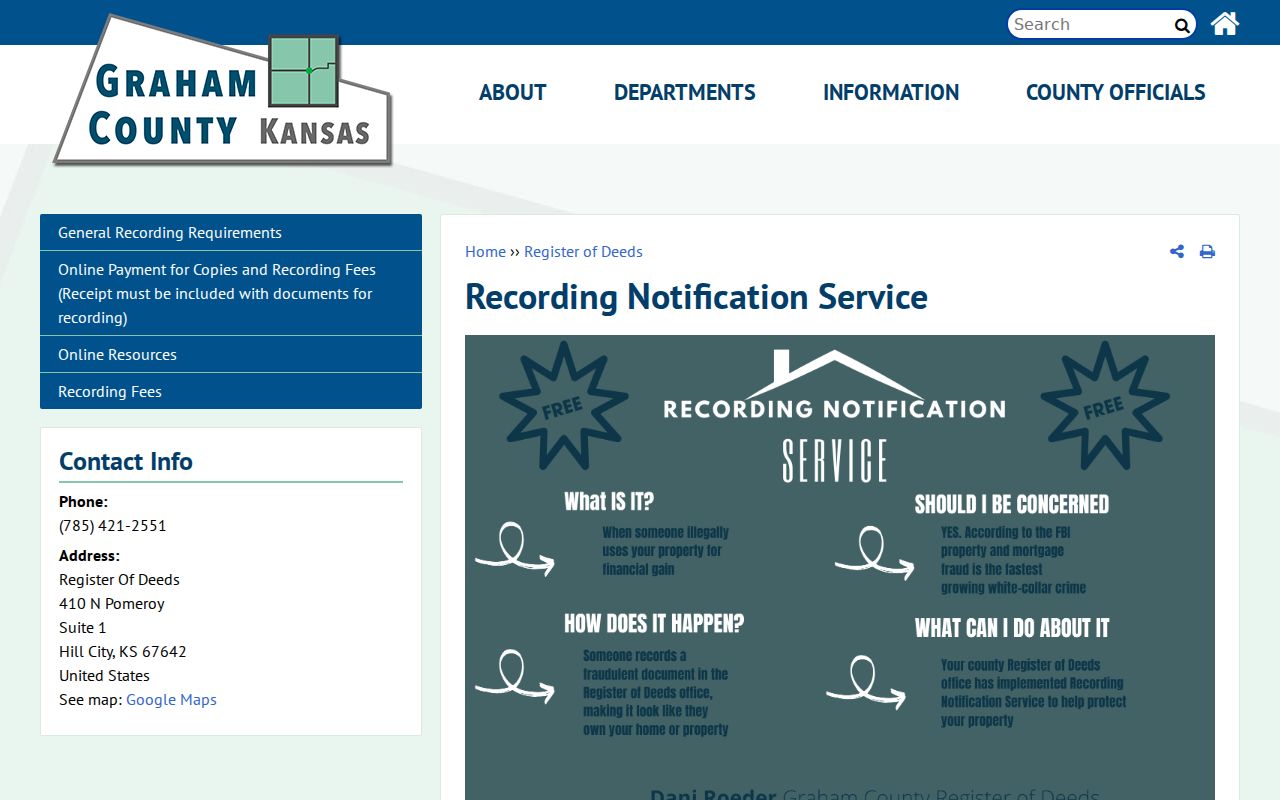
The captured bulletin identifies the county service without relying on an unsolicited message.
Millbrook and Graham Land History
Graham County's land history hides in its place names. A tornado damaged Millbrook on August 4, 1887. The county seat then moved to Hill City on March 10, 1888. That shift is a useful clue. Early notices and administrative references may use either name. Searchers often need both when tracing old parcels and deeds.
Nicodemus opens another deep route into property records. By 1899, homestead patents covered 18,126 acres across 114 claims. Federal patents, tract books, county deeds, and plats can sit alongside National Park Service history. University of Kansas archival material belongs with them too. Use them together. The recorded deed chain, though, remains the source for title.
Graham City Record Clues
Hill City runs its own municipal code. That code answers building, fence, demolition, utility, and inspection questions. Its numbering rules even reach Hillcrest Addition. A Fairview legal description, meanwhile, references a street that was vacated long ago. Bogue and Morland publish no searchable permit portal.
A postal address is not a boundary. Before assuming jurisdiction, check ORKA City Limits for Hill City, Bogue, or Morland. The county still holds each city's deeds, appraisal records, taxes, and parcel framework.
Graham 2026 Value Context
The Appraiser's 2026 market study covers residential neighborhoods. It shows trends ranging from 2 percent to 16 percent. That spread is the whole point. One number does not fit every home. Parcel facts, condition, class, location, and the sales behind each neighborhood all move the outcome.
Set a current value notice beside last year's. Then call the Appraiser inside the stated appeal window. Kansas guidance allows 30 days from mailing for a notice-of-value appeal.
Graham Court Property Cases
Not every land change traces to a normal sale deed. Probate, divorce, partition, quiet-title, foreclosure, and tax-foreclosure cases may hold the missing authority. Search the Kansas district court Public Portal by party name or case number. Then confirm the Graham filing with the district clerk in Suite 9 of the courthouse. The portal reaches back only through the eCourt period. Graham's own start date and copy fee are not published.
A judgment can authorize a transfer. It still stays separate from the recorded land instrument. Copy down the case number, parties, judgment date, and legal description. Ask the Register next about a sheriff's deed, executor's deed, or lis pendens release. Was one recorded there? A matching name on a different tract proves nothing.
Read Graham Legal Descriptions
City land usually carries a lot, block, and addition or subdivision. Rural land leans on section, township, and range, or on metes and bounds, a written walk around the tract's edges. A plat is the recorded drawing behind it all. It lays out lots, blocks, streets, and alleys. The Register will not record a document without an adequate legal description.
Trust the legal description over the street label. Addresses get renumbered. Roads get renamed. Postal routing may even borrow a nearby city's name. Hill City's Fairview mention of a vacated street and Morland's Original Town of Fremont wording show why old plat language still matters. Compare the text with ORKA layers, then pull the recorded plat or vacation instrument. Map geometry helps you find the land. It never changes the words in the instrument.
- Parcel
- A mapped and assessed unit used by the Appraiser and ORKA.
- Plat
- A recorded plan that establishes a subdivision, lots, blocks, and related features.
- Grantor
- The party giving an interest.
- Grantee
- The party receiving that interest.
- Assessed value
- The value after a Kansas class ratio is applied.
Graham Privacy and Requests
The Kansas Open Records Act opens a route to nonexempt public records. Access is not a license to harvest names, though. K.S.A. 45-230 bars obtaining or using lists of names and addresses to sell property or services. ORKA and Hill City both post that use condition. Request a defined parcel, instrument, case, map layer, or date range. Be ready to certify a lawful use.
Kansas Safe at Home gives qualifying victims a substitute legal address with mail forwarding. Never reverse engineer a withheld address through tax, voter, directory, or map data. Public land files may also omit protected details or court-sealed material. Ask the custodian about redaction instead of assuming a blank field means nothing exists.
A strong written request names the office and describes the record precisely. Add the legal description or case and instrument references. Give a date range. Ask about inspection, electronic copies, certification, cost, and delivery. If denied, request the legal basis in writing.
Graham Record Verification
Official sources have different update dates. The Appraiser values property as of January 1. A deed is anchored by its recording date. The Treasurer applies the tax calendar, and court dockets change as cases proceed. Capture the source, search date, tax or assessment year, and recording or case reference with each finding.
For a recent purchase, compare the roll's owner with the newest deed grantee and the exact legal description. For a fence or acreage question, use the recorded plat and a licensed surveyor. For current taxes, ask the Treasurer rather than calculating from an old levy. For liens, search forward for releases and satisfactions. These checks turn disconnected Graham County property records into a documented trail without overstating what one database proves.
Plan a productive records day in Graham County.
Most record custodians here share one building. The Register of Deeds sits in Suite 1. The Appraiser is in Suite 2, the Treasurer in Suite 4, and the district clerk in Suite 9. All are at 410 North Pomeroy Avenue. Close quarters do not mean shared files. Each office keeps its own indexes. Bring a separate question list for every custodian. Store each office's reference numbers alongside its copies so nothing gets tangled later.
Work in a sensible order. With only an address in hand, start with the Appraiser or ORKA. Note the exact owner spelling, parcel key, legal description, tax year, and map context shown there. Then carry the legal description and party names to the Register of Deeds. Request the newest deed, its recording reference, and any corrective instrument filed after it. Liens take extra legwork. Mortgages, assignments, releases, judgments, tax liens, and lis pendens each need their own search. The Treasurer comes last. Ask there for the named tax year and current payment status on the tax roll. Probate, divorce, foreclosure, partition, or quiet title disputes belong at the district clerk. Those cases often explain why a transfer happened.
Check the Register's schedule before you drive over. The office publishes hours of Monday through Friday, 8 a.m. to noon and 1 p.m. to 5 p.m. It sets a 4 p.m. cutoff for same-day document processing. A research request is not the same as presenting a deed for recording. For a complete title search, staff may point you to an abstract or title company instead.
Handle Graham record dates with care.
Every property history holds two clocks. An event happens on one date and enters the public record on another. A deed carries an execution date and, often later, a recording date. The appraisal roll fixes January 1 as its valuation point. Tax statements go out near the end of the year. Court files shift with every new filing and order. Keep these dates in separate columns rather than one forced timeline.
Kansas sales-validation rules require recorded-transfer sales to be entered by the tenth day of each month. That deadline covers transfers recorded through the prior month. It governs state reporting. It says nothing about when Graham County refreshes its public owner display. The county publishes no fixed deed-to-roll interval. For a recent sale, trust the recorded deed date and the named grantee. These are your transfer anchors. Turn to the appraisal record for the current assessment cycle.
Historic digging rewards the same discipline. Newspapers, directories, obituaries, museum files, and genealogy transcriptions can surface a name. A plat or an old address may surface there too. Treat them as leads, not answers. Confirm every lead against the deed book, recorded plat, probate file, patent, or another primary land record. Then you can call anyone the owner of record.