
Graham Deed Types and Uses
Deeds and most land instruments in Graham County pass through the Register of Deeds. Recording puts an instrument into the public chain where anyone can find it. But recording proves nothing about ownership beyond that. The office does not certify that a transferor held every interest claimed, nor that no outside claim exists.
| Deed Type | What It Does | Common Use |
|---|---|---|
| Warranty deed | Conveys the stated estate with deed covenants | Ordinary arm's-length transfer |
| Quitclaim deed | Conveys the grantor's interest without broad title promises | Family transfer or title cleanup |
| Executor or administrator deed | Transfers land through estate authority | Probate-related conveyance |
| Trustee deed | Conveys under a trust or other granted authority | Trust administration or authorized sale |
| Corrective deed | Corrects a defect in an earlier instrument | Name, description, or drafting correction |
A mortgage exists to secure a debt. Its release or satisfaction comes later, showing the claim was paid off. Oil and gas leases need their own review. Easements do too. Assignments, tax liens, lis pendens, judgments, and plats each deserve separate attention. One deed never summarizes them all. Plan a Graham County property records search that treats these instruments separately.
Graham Register of Deeds
The Register of Deeds sits at 410 North Pomeroy Avenue, Suite 1, Hill City, Kansas 67642. Hours run Monday through Friday. The office is open 8 a.m. to noon and 1 p.m. to 5 p.m. Documents must arrive by 4 p.m. for same-day processing. Call 785-421-2551 or check the official Register of Deeds page before visiting.
The Register covers Hill City, Bogue, Morland, Nicodemus, Penokee, St. Peter, and rural Graham County. The county hosts no public deed index or online search form of its own. Give staff names, a rough year, and the document type. Add a legal description so they can pull the right records fast.
Graham Recorded Instrument Scope
County materials list deeds, mortgages, assignments and releases. Oil and gas leases and UCC filings appear there too. Federal and state tax liens and mechanics liens on personal property are included. Corporation papers, powers of attorney, school records, military discharges, and plats round out the set. When researching land, request any re-recording or corrective deed. Ask for later releases tied to the same legal description.
Filing requirements include original signatures, notarization, and the notary seal. Typed or printed names are needed. There must be enough recording space and a sufficient legal description. Kansas sales-validation rules may demand a Sales Validation Questionnaire or a stated exemption. Rural Graham County land is described by metes and bounds. It can also run by section, township, and range. City parcels usually run by lot, block, and addition.
Graham Grantor-Grantee Chain
A chain of title is the ordered run of transfers affecting one tract. Start with the newest confirmed deed. Read the index in both party directions, grantor and grantee alike. Names alone make weak keys. So a Graham County property search should keep the legal description beside every result.
- Find the latest deed with the present party as grantee and confirm the tract description.
- Read its grantor, deed date, recording date, and recording reference.
- Search that grantor as a grantee in the earlier acquisition, then repeat.
- Check probate, divorce, tax-sale, and quiet-title files when an ordinary deed does not bridge the chain.
- Ask which older deed books, indexes, or microfilm cover the period because no online cutoff is published.
- Grantor
- The party giving or conveying the stated interest.
- Grantee
- The party receiving the interest.
- Chain of title
- The linked sequence of recorded transfers for one tract.
- Book and page
- A volume reference used to retrieve an older recorded item.
- Instrument number
- A unique recording reference used in some record systems.
Get a Graham Deed Copy
Reach out to the Register of Deeds with a recording reference. You can also send the best names, date range, and legal description you have. The published schedule charges $21 for the first page. Each added page of a deed, mortgage, or other instrument costs $17. Certification costs $13, and an acknowledgment runs $12.50. Recording a town plat costs $32 per page. These are recording and certification charges only, not research service or a quoted plain-copy price.
Recorded, not guaranteed. Graham deed records show instruments accepted for recording. They are not a title opinion, and the county refers complete searches to title and abstract professionals.
Graham Mortgage Release Checks
A mortgage sitting beside a deed does not mean the debt still stands. Search forward for assignments, modifications, and a release or satisfaction citing the original recording. The fee schedule covers mortgage assignments and releases. They cost $20 for the first page. Each additional page is $4. Federal tax-lien notices and releases cost $32 each, and a lis pendens filing is $5.
Oil and gas leases can carry their own assignments, memoranda, surrenders, or releases. UCC material may cover personal property, business collateral, or fixtures. Read the collateral description before treating it as a land lien. Graham County deed records reward that extra pass.
Graham Recording Alerts
The county publishes a Recording Notification Service notice. An alert tells a subscriber when a new instrument is recorded under a monitored name. It cannot block a filing, verify identity, or insure title. Use it after a purchase or as part of fraud awareness. Confirm any message through the county's official contact. Never pay or sign in through an unsolicited link.
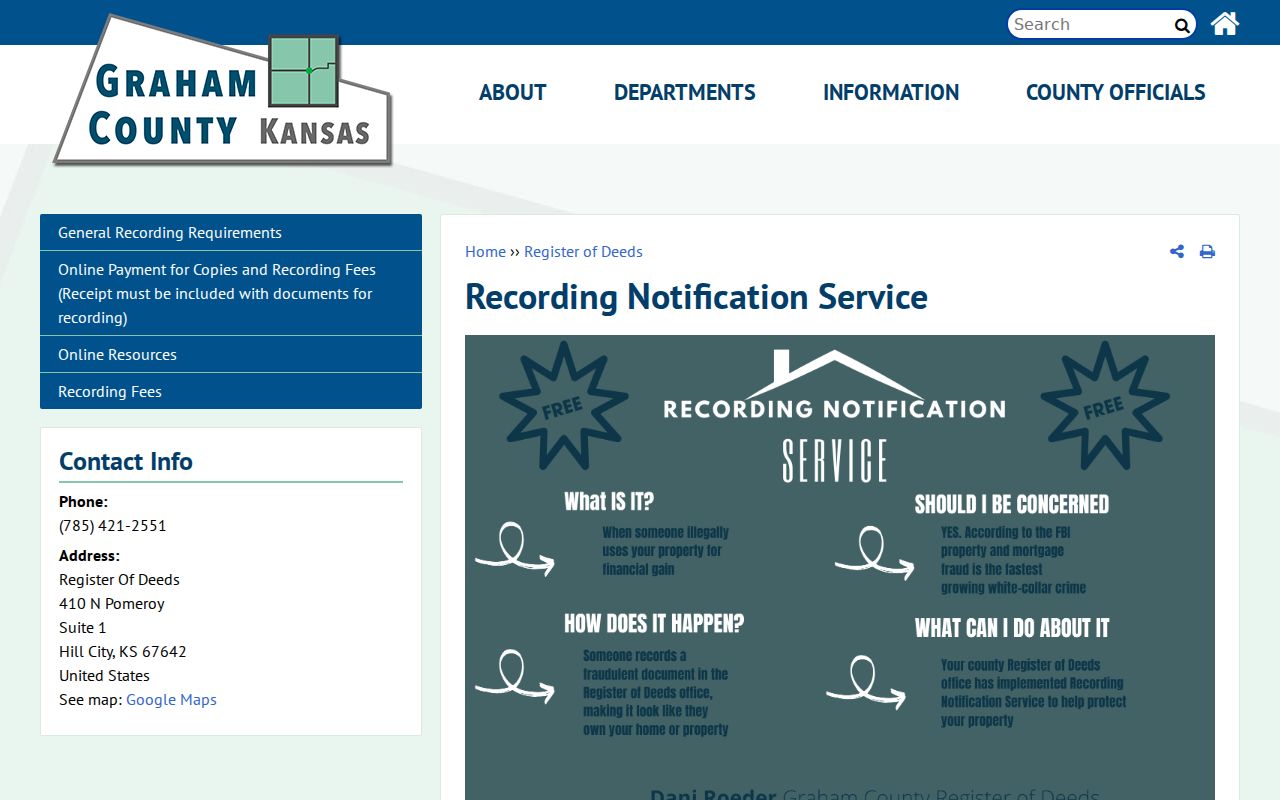
Note: The county bulletin announcing the service is the official source for the signup route.
Historic Graham Deed Clues
Early Graham County deed records research may surface Millbrook. Millbrook was the former county seat. It was damaged by an August 4, 1887 tornado. The seat moved to Hill City on March 10, 1888. That move explains odd administrative references in old papers. The exact deed-book transfer inventory, though, is not documented.
Townsite language preserves older place names. One Morland notice reads "Original Town of Fremont, now City of Morland." Hill City notices cite McGill's, Fairview, and Miles additions. A vacated-street reference is included. Use those exact plat phrases to bridge changed addresses. Then confirm the recorded plat and deed.
Graham Plat and Description Links
A deed's legal description is what ties a party index to one tract. City land is described with lots, blocks, and additions. Rural filings lean on section, township, and range, or on metes and bounds. A recorded plat can add the subdivision name, streets, alleys, lots, and blocks. It can also show the surveyor, approval facts, and recording reference. Ask the Register for the image and for any later vacation or replat.
ORKA's Subdivisions and Lots and Blocks layers help you find the text. But a mapped line is not the legal instrument. A description may name a vacated street, outlot, exception, or earlier plat. Search that language exactly. A surveyor settles a boundary in the field. The deed search documents the recorded interests.
Graham Broken Deed Chains
A clean seller-to-buyer chain can break. Probate, divorce, quiet-title, partition, foreclosure, and tax-sale cases all interrupt it. Search the Kansas district court Public Portal for the parties and case number. Obtain the order that carries the legal description. Then look for the executor, administrator, sheriff, trustee, or tax deed it authorized. The order supplies the authority. The later recording places the conveyance in the land records.
Never bridge a gap with an obituary or directory alone. Those sources only suggest a name or a date. The deed, court file, probate authority, and plat must align. Only then does a former owner join the chain.
Prepare a Graham Deed Request
A focused request saves the Register from having to guess which land or party is meant. Supply the grantor and grantee names exactly as known, including initials or entity suffixes. Add the legal description, approximate recording year, instrument type, and any book, page, or instrument reference. If the deed itself is unknown, begin with ORKA or the Appraiser to recover the legal description.
State whether inspection, a plain copy, or a certified copy is needed. Certification confirms the copy as an official reproduction; it does not insure title. Ask for the copy charge and delivery method because the published schedule clearly lists recording and certification fees but does not establish a complete online image or plain-copy price schedule. Never assume that paying the recording fee buys a historic search.
For a chain, request the index route rather than one guessed deed. The newest grantee should link to the prior grantor on the same tract. Continue backward and save every date and reference. If the office cannot perform the research, follow its stated direction to a title company or abstract office.
Read Graham Recording Dates
The date signed and the date recorded can differ. A deed may be signed at closing. It can reach the county record much later. For a recent ownership question, the recording date is the firm anchor to compare with the grantee, legal description, and any later corrective deed. The annual appraisal roll can still list the prior party, because the county does not publish its owner-roll update lag.
A corrective deed deserves careful review. It may fix a name, acknowledgment, exhibit, or description without representing a new arm's-length sale. Keep the original and corrected references together. A mortgage release is a later document, not an edit to the original mortgage, so search forward in time for each discharge.
Kansas sales-validation paperwork can accompany a transfer or claim an exemption. It does not replace the deed. The parties and legal description remain the core links. Sale-price fields on an appraisal result, when displayed, should be checked against the recorded transfer material before being treated as authoritative.
Trace Graham Historic Owners
The county publishes no online index cutoff. It does not say how far back a browser can search Graham deeds. Ask the Register about the earliest grantor and grantee index. Ask too about the available deed books, microfilm, plat books, and the process for older copies. The Kansas Historical Society can add archival and newspaper context, but the recorded county instruments remain the ownership chain.
Historic place language is often the key. Search Fremont with Morland. Pair Millbrook with early county administration. Use the exact addition names found in Hill City descriptions. Nicodemus land history can lead to federal patents and tract books. Pair each patent or historic notice with later Graham County deeds, so the federal or townsite origin connects to the present chain.