
Compare Graham County Property Values
In Graham County, the Graham County Appraiser sets a fair market value for every parcel each January 1, then applies Kansas classification rules to convert that figure into an assessed value. Property records reflect two different numbers, so know which one you are reading.
| Value | What It Is | Where |
|---|---|---|
| Appraised market value | County estimate of fair market value for the valuation date | Appraiser record |
| Assessed value | Appraised value after the constitutional class ratio is applied | Appraiser record |
| Taxable value | The value used after applicable treatment or exemption | Assessment and tax record |
| Sale consideration | The amount reported for a transfer, when public and shown | Deed, sales data, or validation record |
Kansas property classes do not share a single ratio. Residential real property is generally assessed at 11.5 percent of appraised value, while other classes use different percentages and agricultural land follows use-value rules. Assessed value is therefore not a second opinion on sale price.
Graham Values Begin January First
The annual valuation date anchors the Graham County property value record. Everything keys to January 1. Physical changes, corrected data, parcel divisions, qualifying use, and market evidence can each move the next figure. The Appraiser gathers ownership, location, sales, measurements, construction, and income information to build it.
Always check the year beside a number. Matching one year's assessed value against another year's sale price hides both the valuation date and the ratio. An owner of record label can also lag a closing. The deed may have been recorded even so.
Graham's 2026 Market Study
The county's Market Study Analysis 2026 reports a general residential neighborhood trend upward by roughly 2 to 16 percent. It also shows a general upward commercial trend. Vacant real estate gets no general trend. Those are broad findings. They are not automatic parcel increases.
Changes, corrections, and comparable sales can pull an individual value either way. The study gives useful market context. But the parcel record remains the source for the actual Graham County assessed value.
Look Up Graham County Value
Use the parcel number as the common key. A name search can return several tracts, and an address can fail on rural land. The exact legal description confirms that the value belongs to the intended parcel.
- Open Graham County ORKA from the Appraiser page and locate the tract.
- Confirm the parcel key, legal description, classification, and valuation year.
- Read the appraised and assessed values without treating them as synonyms.
- Check a recorded transfer separately when sale consideration is relevant.
- Assessed value
- The appraised amount after the legal class ratio is applied.
- Market or appraised value
- The county's mass-appraisal estimate for the valuation date.
- Assessment ratio
- The percentage used to convert appraised value to assessed value.
- Sale consideration
- The amount stated or reported for a transfer, subject to record limits.
- Reassessment
- The recurring process of reviewing and setting a new tax-year value.
Sales Do Not Equal Graham Values
A deed records a conveyance, while Kansas sales information feeds appraisal analysis. Not every sale reflects an open-market deal. Some are atypical, transfer only part of an interest, or carry terms that distort the price, so the recorded amount should never be pasted over the assessor's figure.
Compare date, parcel, deed type, and legal description. After a recent closing, remember that county systems update on different schedules. No official source states a precise Graham closing-to-roll lag.
Agricultural Graham Land Differs
Kansas values agricultural land through use-based rules. A farm tract's figure is therefore not a residential market estimate. Improvements and other classifications can appear separately. Verify the parcel class before comparing values across nearby land.
The Kansas Department of Revenue's property valuation basics page explains appraised value, assessed value, agricultural use value, and mill levies. It supplies the state context, while the Graham Appraiser supplies the parcel-specific classification and figure.
Exemptions Change Taxable Graham Figures
An exemption or special treatment can push taxable value well below the headline amount. That amount may be appraised or assessed. The gap does not signal a lower market price. Read the exemption and classification fields together with the valuation year.
For bills, due dates, exemptions, and appeal procedure, use the Graham County property tax records. The county Treasurer forms page links Kansas property-tax and protest material. The property-value question stops at what the numbers mean.
Graham Value Access Channels
Online lookup starts at the Graham ORKA landing. Is a parcel missing? Is a label unclear? Contact the Appraiser with a street address, parcel key, or legal description. The office can explain its own valuation record. It can also correct factual parcel data through the proper process.
Recorded sales and deeds come from the Register of Deeds. Newspapers and county records can supply older market color. But none of it replaces the official tax-year value. Keep the source and the year attached to every figure.
Check Graham Value Math Carefully
Kansas publishes a simple tax formula. Multiply the assessed value by the mill levy, then divide by 1,000. That math separates value from tax. It never turns a value record into a bill. Taxing units set their own levies. The Treasurer collects the tax and distributes the money. Anyone studying Graham County property value should stop before payment status, delinquency, or a tax-sale case.
Classification comes first. The state constitutional schedule assigns a different ratio to each property class. Agricultural land is valued by use. Residential property generally carries an 11.5 percent assessment ratio. An appraised figure and an assessed figure are not rival market estimates; one is the valuation base. The other comes from the legal ratio. The parcel's true classification must come from the Graham record.
Market studies group sales and apply appraisal methods. They cannot promise that every parcel moves with the countywide or neighborhood trend. Graham County's published 2026 analysis says individual values can vary because of property changes, data corrections, or comparable sales. Check the notice and the parcel facts first.
A transfer amount also needs context. Confirm the deed covers the same parcel and interest, note its date, and treat family, estate, or partial-interest transactions as anything but ordinary open-market sales without support. A licensed appraiser can adjust comparable sales for a transaction-specific opinion, while the county property value remains an official tax record for its stated year.
Graham Property Data Shapes Value
The Appraiser's real-estate data covers a lot of ground. It holds ownership, location, sale information, measurements, construction details, and income information where relevant. A wrong square footage, class, improvement description, or parcel boundary can shift a mass-appraisal result. Compare the property record with observable facts and recorded land documents. Otherwise a data error may look like market movement.
Corrections and valuation disputes are different tasks. A factual correction fixes bad parcel data. A valuation appeal challenges the value through the annual process. Graham County publishes a tax calendar and links the state forms. Deadlines still depend on the notice and the route used. This explanation does not replace those instructions. Contact the Appraiser promptly when a notice looks wrong.
Neighborhood analysis has limits in a sparse rural county. The county's published market study reports a broad residential trend range, not one rate for Hill City, Bogue, Morland, Nicodemus, or every rural tract. The county publishes no city-only value trend. Applying the high end of a county range to one home invents precision the study never supplied.
Personal property is a separate record class. Boats, vehicles, trailers, campers, aircraft, mobile homes, and qualifying commercial personal property fall under personal-property rules, so keep those assessed amounts apart from the real-property value for land and fixed improvements.
Document a Graham Value Comparison
Write the basics down first. Note the parcel key, class, valuation year, appraised value, and assessed value. Add the source and retrieval date. For a sale, include the transfer date and the deed type. Also note whether the amount covers the same land and interest. This small record prevents mismatches. It stops a current assessed figure from being matched with an older or partial sale.
Comparables need care too. Match class, location, use, and physical features as closely as possible. A nearby parcel can differ in acreage, improvements, agricultural treatment, or city jurisdiction. The county market study only supplies trend context. A licensed appraisal supplies a reasoned parcel-specific comparison.
Limits of Graham Property Value
Graham County relies on mass appraisal. That method values many properties through common data and shared methods rather than one parcel at a time. It is not a private transaction appraisal. It proves no condition, title, boundary, or future offer. Use a licensed appraisal for a transaction-specific opinion, recorded deeds for transfers, surveys for boundaries, and tax records for the bill, because each source answers its own question.
Value is not price. A Graham County assessed value serves taxation. It is not a sale forecast or a private appraisal.
Reach the source through the Graham County Appraiser's official page for annual data.
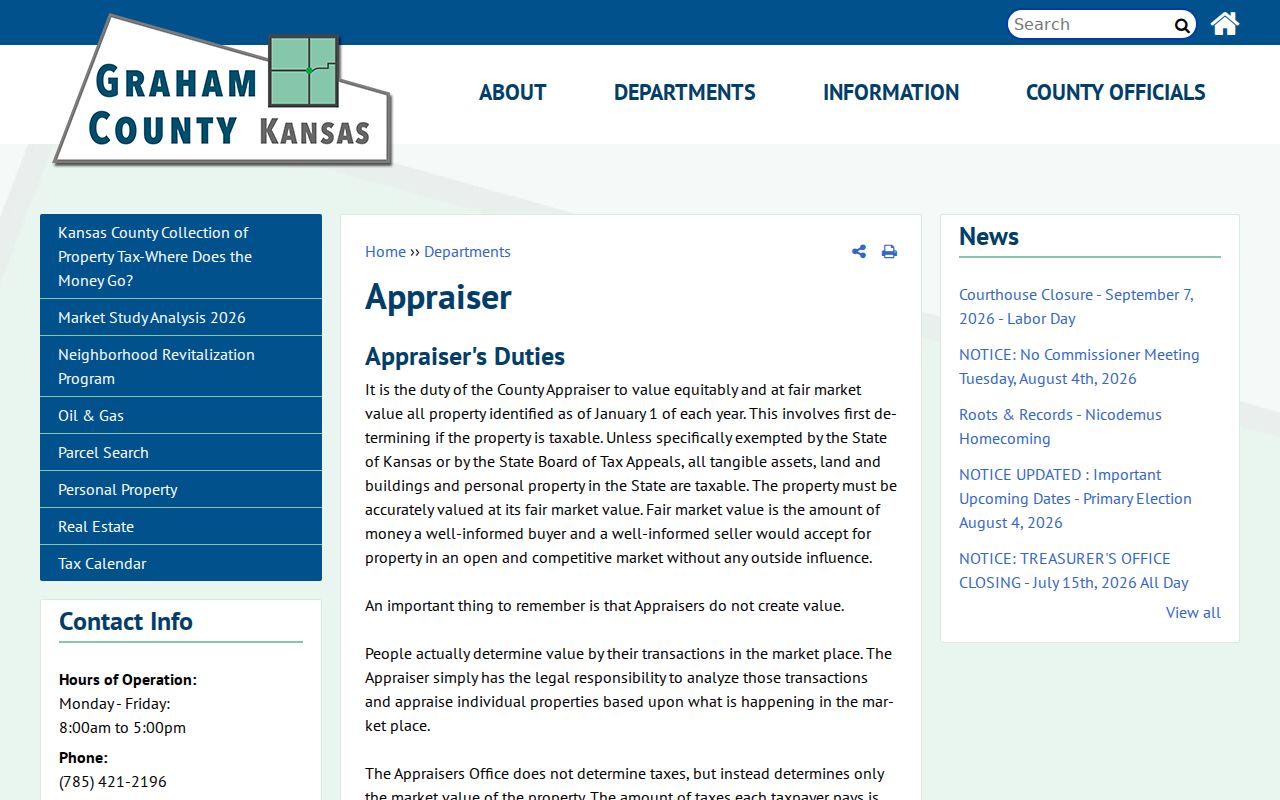
The screen confirms the county's valuation source. A meaningful comparison still needs a live parcel and a matching assessment year.