
Graham Tax Record Coverage
Graham County property tax records pair an appraisal with the tax statement that follows it. The valuation date is January 1. From there the county works through a set cycle of notice, certification, billing, and payment.
| Field | What It Shows | Where |
|---|---|---|
| Fair market or appraised value | County estimate as of the annual valuation date | Appraiser |
| Property class and ratio | Statutory percentage applied to appraised value | Appraiser |
| Assessed value | Appraised value multiplied by the class ratio | Appraiser |
| Tax levy | Rates of county, city, school, and other taxing units | Clerk and tax statement |
| Bill and payment status | Amount billed, installments, receipt, or delinquency | Treasurer |
The basic math is simple. Tax equals assessed value multiplied by the combined mill levy, divided by 1,000, and one mill means one dollar per $1,000 of assessed value. Credits or special assessments may adjust the final figure. Keep in mind that neither the assessed value nor the bill reflects deed consideration or a guaranteed market price.
Graham Kansas Class Ratios
Assessment ratios in Kansas depend on property class. Residential property is assessed at 11.5 percent of appraised value. Vacant lots sit at 12 percent. Commercial and industrial real property sit at 25 percent. Agricultural land is taxed at 30 percent of use value. Other statutory classes carry their own treatment. That makes the class printed on a Graham parcel record worth checking closely.
Picture a $100,000 residential appraised value. It produces $11,500 in assessed value before any levy is applied. The example shows the ratio alone. It is not a Graham parcel estimate. It also leaves out the real levy, special assessments, exemptions, and credits.
Graham Appraiser Parcel Facts
The Graham County Appraiser pulls together ownership, location, use, and sales data. The office also gathers land and building measurements, construction, cost, rental-income, permit, and inspection data to estimate fair market value. Visit the office at 410 North Pomeroy Avenue, Suite 2, Hill City, or call 785-421-2196.
ORKA serves as the public map and report tool. It does not display a full live Graham parcel card. Field labels for owner of record, mailing address, situs, last sale, exemption, and assessment details should be confirmed on a live result. Quote them only after that check.
Look Up Graham Tax Bills
The county publishes no official online Graham tax-bill search. Identify the parcel and legal description through ORKA or the Appraiser first. Then contact the Treasurer at 410 North Pomeroy Avenue, Suite 4, Hill City. The office also takes calls at 785-421-2331. Request the exact tax year, account, statement, receipt, or delinquency status you need.
- Locate the parcel by situs address in ORKA and record the parcel key and legal description.
- Confirm the appraisal year, class, appraised value, and assessed value with the Appraiser.
- Give the Treasurer the parcel details and request the bill, payment record, and installment status for the named year.
- Ask whether a delinquency, publication, county sale, special assessment, or later payment affects the account.
- Appraised value
- The county's estimate of fair market value as of January 1.
- Assessed value
- The appraised or use value multiplied by its statutory class ratio.
- Mill levy
- The combined tax rate stated per $1,000 of assessed value.
- Tax lien
- A legal claim arising from unpaid tax, distinct from the amount first billed.
Appeal Graham Property Value
A property owner can appeal a notice of value within 30 days of its mailing date. That deadline comes from Kansas Department of Revenue guidance. Contact the Appraiser and follow the instructions on the notice. Bring solid facts about the parcel, its condition, class, measurements, and comparable sales. Remember that the clock runs from the mailed notice, not a later tax statement.
Paying under protest is a separate path. It is tied to the tax payment itself. State forms and instructions control how to file correctly. An appeal contests appraisal or classification evidence. It cannot rewrite the recorded deed or settle a boundary dispute.
Appeal window. File within 30 days after the value notice is mailed and keep proof of delivery. Contact the Graham County Appraiser at once if the notice date is unclear.
Graham Property Tax Calendar
January 1 is the assessment date. Real-property value notices go out by March 1. The Appraiser certifies values to the County Clerk on June 1. Later June and July dates cover personal property and final certification work. On November 1, the Clerk certifies taxes to the Treasurer.
Statements are mailed between November 1 and December 15. Full payment or the first half is due December 20 without penalty. The second half comes due May 10. A bill can look complete between those dates even though one installment still remains.
Graham Delinquent Tax Route
Unpaid real-estate taxes are published in the newspaper on August 1, per the county calendar, and the affected property is sold to the county on the first Tuesday in September. That county sale stage is not an immediate private transfer. Kansas statutes provide a later district-court foreclosure route for land that goes unredeemed.
Search Graham public notices by owner and legal description. Confirm the account with the Treasurer and any case with the district court. A 2024 notice lists concrete Hill City, Morland, Nicodemus, and Bogue lot descriptions. A historic notice, though, proves neither current delinquency nor current ownership.
Graham 2026 Market Study
The Appraiser's 2026 market study reports residential neighborhood valuation trends. The trends run between 2 percent and 16 percent. Those figures describe groups used in annual mass appraisal. They do not mean every home rises by the same amount.
Parcel condition, location, use, improvements, classification, and comparable sales each shape a result. Any one of them can push a value up or down. Compare the new notice against the prior record. Then ask which property facts or sales drove the change.
Graham Ratio Study Context
Kansas ratio-study data for 2022 showed a Graham residential median of 92.6 and a coefficient of dispersion of 14.3. The commercial median came in at 80.1. The median compares appraised values against qualifying sales. The coefficient of dispersion measures how widely values spread around that median.
Treat these numbers as historical quality-control context, not current parcel values. They should not be carried forward as a 2026 adjustment. They should not be used to estimate a tax bill.
Graham Exemptions and Programs
An exemption or special-use program changes taxable treatment only when Kansas law and the parcel facts both qualify. Age alone is never enough. Neither are a mailing address, a land use, or last year's bill. Ask the Appraiser which state form applies. Ask what filing date governs it, what proof is required, and which assessment year the decision affects.
A blank field on a public card proves nothing. Confirm the status with the Appraiser directly. Then compare the assessed value used on the Treasurer's statement against the Appraiser's record.
Verify Graham Tax Calculations
Use records from one year only. Start with the appraised or agricultural use value. Apply the proper class ratio. Then use the combined mill levy shown for the parcel's taxing districts, and add or subtract only the credits, exemptions, and special assessments documented on that account.
A city name or ZIP proves little. Postal lines can cross a city boundary, so they do not settle which taxing units apply. If your rebuilt figure differs from the statement, take each question to its custodian. Ask the Appraiser about value and class, the Clerk about levy certification, and the Treasurer about billing, payment, penalty, and distribution, a split that keeps a valuation issue from being mistaken for a payment issue.
Read Graham Tax Statements
Read any Graham County tax statement by tax year, parcel, and taxing district. Confirm the match first. The legal description or parcel key should match the land searched in ORKA. Next, find the assessed value the Treasurer shows. It also lists the combined levy, special assessments, installment amounts, due dates, and payment status. The mailing address only routes the statement. It does not prove occupancy.
Compare the statement's assessed value with the Appraiser's record for the same year. If the figures differ, ask a question. Does a correction, classification change, exemption decision, or later certification apply? The County Clerk certifies the levy and taxes. The Treasurer handles billing, collection, receipts, and distribution. Neither office substitutes for the Appraiser on the parcel's physical facts and value.
Keep full payment and installment payment distinct. December 20 is the full or first-half due date. May 10 is the second-half due date. A receipt for one installment does not by itself prove the full year is paid. Ask for the account status through the date of your request.
Check Graham Delinquency Evidence
A published delinquent-tax notice is a useful lead. It still captures only one stage and one date. Match the owner and legal description, then call the Treasurer for the current balance and status. Payment, redemption, correction, or later court action can change what an older notice means. An archived clipping alone proves nothing.
The county's first-Tuesday September sale is part of the collection process. It does not give a buyer clear title instantly. When unredeemed property proceeds under K.S.A. 79-2801, the county brings a district-court action. The petition identifies owners and interested parties, the amount due, and the claimed lien. K.S.A. 79-2804 addresses judgment and sale procedures.
Search the court case and Register too. A lis pendens may flag the pending suit, a later sheriff or tax-related deed may document a transfer, and a dismissal or redemption can lead elsewhere. Match the legal description before joining any files.
Build a Graham Appeal File
A strong appeal rests on appraisal evidence. Save the value notice and its mailing envelope. Verify the deadline and inspect the property facts the Appraiser used. Check land area, use, classification, building size, age, quality, condition, construction, and any recent permit or inspection entry. Photograph factual condition issues. Then identify comparable sales that truly match the parcel.
Ask which sales and model support the value. The 2026 county study reports a residential neighborhood trend ranging from 2 percent to 16 percent. The parcel's own facts determine its notice. A countywide range is not evidence that one home must change by either endpoint.
File through the notice-of-value route within 30 days of mailing, or use the separate payment-under-protest process when appropriate. Keep proof of timely filing too. An assessment appeal changes value or class when warranted, but it does not change the deed, redraw a boundary, or erase a tax balance without the corresponding tax action.
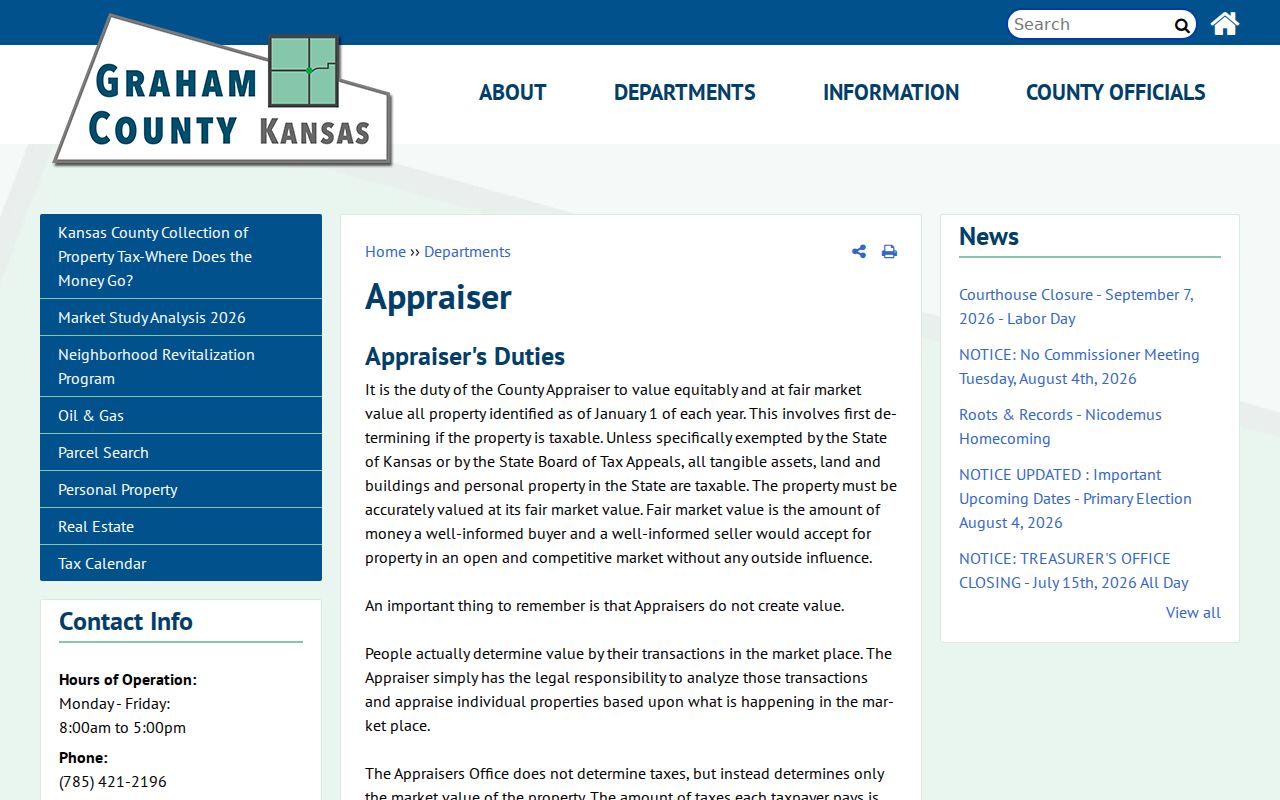
The Graham County Appraiser page explains the office's valuation duties and links into its parcel data.
Payment and delinquency questions still go to the Treasurer.